My First Reflection…
A question I’ve been pondering recently is “what is the purpose of education for children?”. As an adult, I view my personal education as a method to become more informed about things I am passionate or curious about, as well as my duty to be informed about the goings on in the world. My goal is to be a proficient member of culture and society to aid in its development. But when we consider education for children, I am not sure its purpose is the same as for adults. Because the typical education experience for young students is led through an adult’s direction with end goals in mind, there are inevitable biases that will seep into the information given.
Visiting Pacific School of Innovation & Inquiry recently put words (and feelings) to a lot of this uncertainty for me. Walking through the school, I was struck by how different the atmosphere felt from the classrooms I grew up in. Students weren’t being “delivered” information so much as they were actively engaged in figuring things out, asking questions, and making meaning alongside educators.
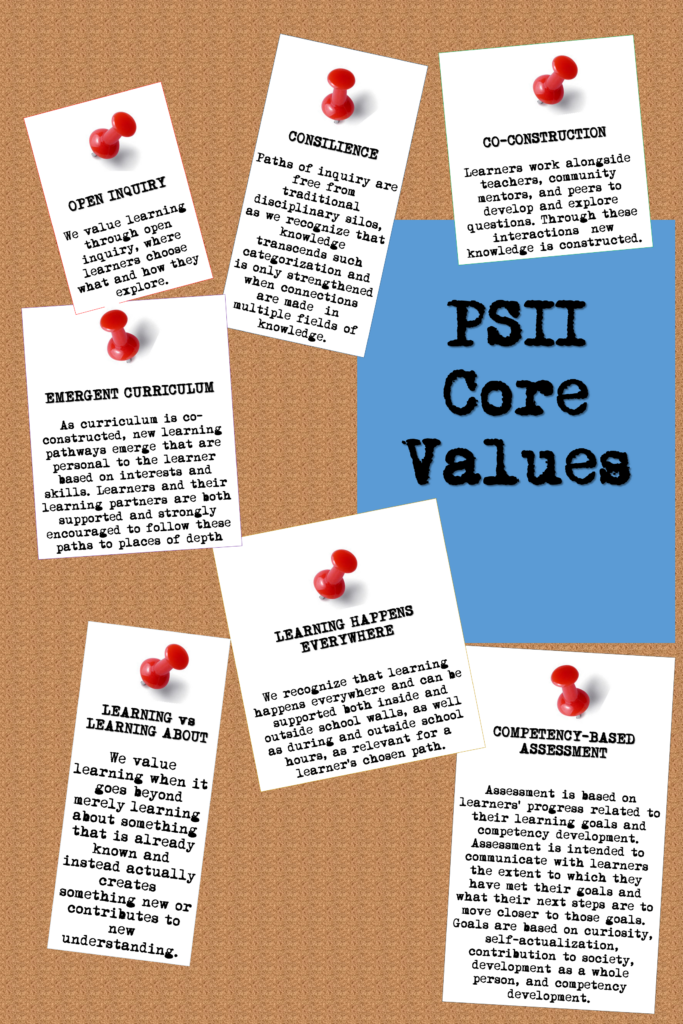
Following the observation, I have more questions about education than answers. Curriculum requirements, standardized testing, time constraints, class sizes, and institutional expectations all exert pressure to teach in familiar, measurable ways. Watching educators at PSII navigate this made it clear that this approach requires not just different methods, but a fundamentally different mindset. I am curious how this change works for everyone. I am aware that the current ‘normal’ education experience is not one that ‘works’ for all, but is the change better? Is it feasible for teachers? What pieces are inevitably missing to ensure inclusive understandings while also ensuring each student is developing. How does educator bias play a role in this format?
Even though there are inevitable pitfalls, students developing a personal learning approach can develop motivation, adaptability, critical thinking, and a sense of agency, all of which will aid in all aspects of life. Rather than learning how to perform school, students learn how to learn which is invaluable.